
If you own or manage a building with a flat or low slope roof in Ontario, you will eventually be asked to choose between three systems: TPO, EPDM and modified bitumen. Most comparisons you will find were written for the American market, where the climate argument runs in a different direction than it does here.
This guide compares the three on the terms that actually matter north of Lake Ontario: how each behaves through a freeze and thaw winter, how each fails, what each costs to maintain, and which type of building each genuinely suits. We have installed and repaired all three across Ajax, Durham Region and the GTA since the 1980s.
The short answer
If you want the recommendation before the reasoning:
- Choose TPO if the building is newer, the roof is largely clear of foot traffic and rooftop equipment, and cooling costs or a future solar installation matter to you.
- Choose EPDM if you want the longest proven track record in cold weather, the roof has complex penetrations, and you value repairability over energy performance.
- Choose modified bitumen if the roof takes regular foot traffic, carries heavy mechanical plant, or is an older assembly where a robust multi ply system is the safer answer.
There is no universally best flat roof. There is a best fit for a specific deck, a specific use and a specific budget, which is why we quote after we have been on the roof rather than before.
Why Ontario changes the comparison
Three regional factors reorder the usual advice.
Freeze and thaw is the main stress, not heat
Southern Ontario cycles through freezing repeatedly each winter. Every cycle expands and contracts the membrane and everything it is fastened to. A material that stays flexible at low temperature will outlast one that stiffens, regardless of what its warranty says. This is the single most important property for a roof in this climate, and it is the one most American comparisons underweight.
The cool roof argument is weaker here than in the south
White reflective membranes are marketed on cooling savings. In Ontario, heating demand substantially exceeds cooling demand across the year, so the net energy benefit of a reflective roof is smaller here than in Texas or Arizona.
That does not make reflectivity worthless. A lighter surface runs cooler in summer, which reduces thermal cycling and tends to extend membrane life, and it lowers peak summer cooling load. But if a supplier presents a white roof as an obvious energy win in Ontario, treat the claim carefully. The real benefits here are membrane longevity and peak load, not a large annual heating and cooling saving.
Insulation depth is set by code, not by preference
Whichever membrane you choose, the assembly beneath it has to meet the effective thermal resistance the Ontario Building Code requires for your building type. In practice insulation accounts for most of the thickness of a commercial roof, and the membrane itself is a thin layer on top. That has a practical consequence at quoting time: two proposals with very different prices are often differing on insulation, not on membrane.
TPO, the energy efficient single ply
TPO is a thermoplastic single ply membrane, most often white, that arrives in wide rolls and is fastened or adhered over the insulation.
How it performs
Its defining feature is the seam. TPO seams are welded with hot air, which fuses the sheets into one continuous piece of material. A properly welded seam is generally as strong as the membrane itself, which removes the most common failure point on a single ply roof. That single property is the strongest argument for TPO.
The reflective surface reduces summer surface temperature, which slows the thermal cycling that ages every membrane. On newer buildings with clean, uncluttered roof decks, TPO installs quickly and cleanly.
Where it is weaker
TPO is the newest of the three systems, and formulations have changed considerably over the years. That means the long term field record is shorter than for EPDM, and quality varies more between manufacturers than buyers expect. Specifying a reputable manufacturer matters more with TPO than with the other two.
It is also less forgiving of a poor install. Because the seam is welded, weld quality determines roof life, and a weld made in the wrong conditions can look acceptable and still fail.
Best suited to
Newer commercial and industrial buildings, retail plazas, and any roof where a future solar array is likely. See our commercial flat roof installation page for how we specify these assemblies.
EPDM, the long track record in cold weather
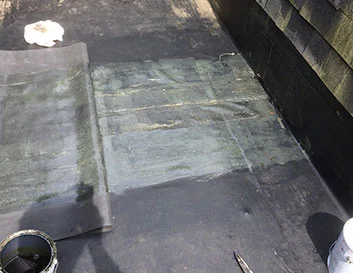
EPDM is a synthetic rubber membrane, usually black, and it has been installed in North America since the 1960s. When people say a flat roof lasted thirty years, it is very often EPDM they are describing.
How it performs
EPDM stays flexible at low temperatures. In a climate that cycles through freezing repeatedly, that flexibility is not a specification detail, it is the reason the roof survives. It also handles ultraviolet exposure well and resists ozone and weathering.
It is the most repairable of the three. A puncture in EPDM can be patched cleanly and reliably, often quickly and at low cost, which matters on a roof with heavy rooftop equipment or frequent service access.
The black surface is sometimes treated as a drawback. In Ontario it has a practical benefit: a dark roof absorbs solar heat, which helps clear snow and ice more quickly than a white surface does.
Where it is weaker
The seams are the historic weak point. EPDM sheets are joined with adhesives or seam tape rather than welded, and while modern tapes are far better than early adhesives, seams remain the first place an EPDM roof is likely to open. Seam condition is the first thing we check on an EPDM inspection.
It also offers no reflective benefit, and on a building with high summer cooling load that is a genuine consideration.
Best suited to
Buildings where longevity and repairability outrank energy performance, roofs with many penetrations, and any owner who wants the most predictable system of the three. If yours is already leaking, see commercial flat roof repair.
Modified bitumen, the multi ply workhorse

Modified bitumen is asphalt reinforced with polymers and a fabric mat, applied in two or more layers. It is the modern descendant of traditional built up tar and gravel roofing.
How it performs
Its strength is redundancy. Because it is installed in multiple plies, a puncture through the cap sheet does not automatically mean water in the building. For roofs that take regular foot traffic, carry mechanical plant, or serve restaurants and industrial processes, that redundancy is worth a great deal.
The granulated cap sheet resists physical damage better than either single ply option. It is the system we most often recommend where people will be walking on the roof regularly.
The SBS and APP distinction matters in Canada
Modified bitumen comes in two polymer types, and the difference is not marketing. SBS modified bitumen remains flexible at low temperatures. APP is formulated for heat resistance and is more at home in hot climates.
For Ontario, SBS is generally the appropriate specification. If a quote does not tell you which one it includes, ask, because it is one of the few material choices on a flat roof where the wrong answer is climatically wrong rather than merely suboptimal.
Where it is weaker
It is heavier than single ply, which occasionally matters on a marginal deck. Torch applied installation involves an open flame, which requires proper safety procedure and is not appropriate on every building, though cold applied and self adhered options exist for exactly that reason. It is also usually the slowest of the three to install.
Best suited to
Roofs with foot traffic, heavy rooftop equipment, restaurants, industrial buildings, and older assemblies where a robust multi ply system is the conservative choice.
Side by side comparison
| TPO | EPDM | Modified bitumen | |
|---|---|---|---|
| Type | Thermoplastic single ply | Synthetic rubber single ply | Multi ply asphalt |
| Seams | Heat welded, fused | Adhesive or tape | Torch, cold adhesive or self adhered, overlapped plies |
| Cold flexibility | Good | Excellent | Excellent with SBS |
| Foot traffic | Moderate | Moderate | Best of the three |
| Reflectivity | High, usually white | Low, usually black | Low to moderate |
| Repairability | Requires welding equipment | Easiest and cheapest | Straightforward, ply dependent |
| Track record | Shortest | Longest | Long |
| Typical weak point | Weld quality | Seam adhesion | Detail work at flashings |
| Relative install cost | Low to moderate | Moderate | Moderate to high |
Cost ranges are deliberately left relative. Membrane price is rarely what separates two quotes on the same building. Insulation depth, deck condition, tear off, access and the amount of flashing and penetration detail move the number far more.
What actually decides it for your building
In practice the specification is settled by five questions, and the membrane is usually the last of them.
1. Who walks on the roof, and how often
If service technicians are on the roof monthly, redundancy matters more than reflectivity. That points to modified bitumen, or to a single ply with walkway pads installed properly.
2. What is on the roof
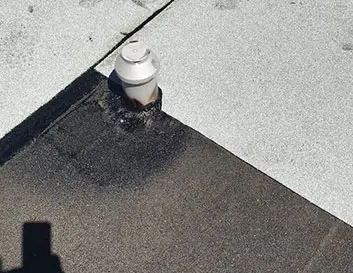
Every unit, vent, curb and drain is a penetration, and penetrations are where flat roofs actually leak. A roof crowded with equipment favours a system that is easy to detail and easy to repair, which is an argument for EPDM.
3. What the deck can carry
An older deck, or one already carrying significant load, may rule out the heaviest assembly before any other consideration.
4. Whether solar is coming
If a solar array is planned within the roof’s life, decide that now. Mounting through a finished membrane after the fact is far more expensive and far more likely to leak than integrating it at installation.
5. How long you intend to hold the building
An owner planning to sell in five years and an owner holding for twenty are making different decisions, and both are legitimate. Say which you are when you ask for a quote, because it genuinely changes the recommendation.
The mistake that costs more than the membrane choice
Whichever system you select, the largest single predictor of how long the roof lasts is not the material. It is whether anyone maintains it.
Most commercial roofs do not fail because the wrong membrane was chosen. They fail because a drain stayed blocked, a seam opened and nobody looked, or a flashing lifted and stayed lifted for two winters. By the time water shows on the ceiling it is usually in the insulation, and the repair has changed from a seam to a section.
There is a second cost to neglect that owners often discover too late: most manufacturer warranties require documented maintenance, and an undocumented roof can leave you holding a warranty you can no longer claim on. Scheduled inspection is the cheapest money you will spend on a flat roof. See our commercial roofing services for how our maintenance programs work.
Frequently asked questions
Which flat roof system lasts longest in Ontario?
EPDM has the longest proven field record in cold climates, and well maintained EPDM roofs commonly reach the far end of their expected service life. That said, a well installed and maintained TPO or SBS modified bitumen roof will outlast a poorly installed EPDM one. Installation quality and maintenance influence lifespan more than the choice between these three materials.
Is TPO or EPDM better for a Canadian winter?
Both perform in cold weather, for different reasons. EPDM stays highly flexible at low temperature and is the more forgiving material through freeze and thaw. TPO offers a welded seam, which removes the most common single ply failure point. If the roof is complex and full of penetrations, EPDM is often the safer answer. If it is a clean, open deck, TPO is very competitive.
What is the difference between SBS and APP modified bitumen?
SBS is modified for flexibility at low temperature. APP is modified for heat resistance. In Ontario, SBS is generally the correct specification, and it is worth confirming which one a quote includes.
Can I install a new flat roof over the old one?
Sometimes. It depends on how many layers are already there, whether the existing insulation is wet, and what the deck can carry. Overlaying a wet assembly traps the moisture and shortens the new roof’s life, so this is decided by inspection, not by preference.
How much does a commercial flat roof cost in the GTA?
It is quoted by system, insulation depth and access rather than by square footage alone. Two buildings of identical size can differ substantially if one needs a tear off and the other does not, or if one has no driveway access and a laneway at the rear. We provide a written scope and a fixed price after inspecting the roof.
How often should a commercial flat roof be inspected?
Twice a year is the standard recommendation, in spring and autumn, plus after any severe weather. Spring identifies winter damage while it is still small, and autumn clears the drains before they matter most.
Get a system recommendation for your building
We install and repair all three systems across Ajax, Pickering, Whitby, Oshawa, Scarborough, Markham and Toronto.
Book a free inspection and you will get a plain explanation of which system suits the roof and why, and a written price with no obligation. If a repair is the honest answer rather than a replacement, we will tell you that too. For an existing problem, start with commercial roof repair.
Call 416-417-5656 or request a free estimate.
References
- Ontario Building Code, energy efficiency requirements for building assemblies, ontario.ca
- Canadian Roofing Contractors Association, roofingcanada.com
- National Roofing Contractors Association, nrca.net
- Natural Resources Canada, energy efficiency guidance for commercial buildings, nrcan.gc.ca